





























Corporate event management in Spain: a guide for international Companies


Your Madrid or Barcelona office just got the green light for a kickoff, a client dinner, or a full company offsite, and someone on your team, probably you, now has to find venues and suppliers in a country where you don't have a local network, might not speak the language fluently, and have no idea how Spanish invoicing or contracts actually work. Corporate event management in Spain looks simple from a distance. It stops looking simple the moment you start emailing venues that never reply, or reply only in Spanish.
That gap between "this should be easy" and "why has nobody answered my email in four days" is where most international teams lose time. Not because the market lacks good venues, caterers or AV companies. Spain has plenty. The problem is finding and vetting them from another country, coordinating everything across time zones, and making sure the event actually runs the way it looked on paper.
What corporate event management in Spain actually involves
For a company based outside Spain, managing an event here breaks down into four distinct jobs, and most teams underestimate how much each one takes.
Sourcing and vetting suppliers. Finding a venue is the easy part; Google gets you a list in minutes. Knowing which of those venues will actually show up with the AV setup they promised, or which catering company handles 200 covers without a hitch, is a different problem entirely. Reviews only tell you so much, and a beautiful website says nothing about how a supplier behaves three days before your event when something changes.
Contracts and paperwork. Spanish suppliers work under Spanish contract law, invoice with Spanish VAT (IVA) rules, and often expect deposits structured differently than what your finance team is used to. None of this is exotic once you know it, but it slows everything down the first time.
Logistics across a language and a time zone. Most large venues and international-facing suppliers in Madrid and Barcelona operate comfortably in English. Smaller, often better, options frequently don't. A three-hour email back-and-forth about dietary requirements becomes a two-day delay when your supplier only checks messages at the end of the working day and you're nine time zones apart.
Someone on the ground on the day. Even a well-planned event needs a person physically present who can solve a last-minute problem: a delivery that's late, a room that's set up wrong, a guest list that doesn't match the door count. If your whole team is flying in the morning of the event, that person doesn't exist yet.
The kind of events international companies run in Spain
Spain has become a regular stop for companies headquartered elsewhere, and the reasons come up again and again in the briefs we see: good year-round weather, strong flight connections to most of Europe, and costs that are noticeably lower than London, Paris or Zurich for a comparable event.
The most common formats we see from international teams are:
- Kickoffs and offsites for a regional or global team, usually combining a day or two of working sessions with something social.
- Product launches, particularly for companies expanding into the Spanish or Southern European market and wanting a local moment to mark it.
- Client-facing events: dinners, showcases, small conferences aimed at Spanish or regional clients.
- Internal town halls or all-hands when a company has a growing Spanish office and wants the whole team in one room at least once a year.
Each of these has a different tolerance for risk. A client dinner going slightly wrong is embarrassing. A 300-person kickoff going wrong in front of your whole leadership team is a different kind of problem, and it's exactly the scenario that makes companies start looking for a local partner instead of trying to run it all from an inbox abroad.
Madrid, Barcelona, or somewhere else
The two cities cover most requests we get from companies outside Spain, and they're not interchangeable.
| City | Strongest for | Flight connections | Language ease |
|---|---|---|---|
| Madrid | Corporate, finance, government-adjacent audiences | Excellent | Good in business venues |
| Barcelona | Tech, creative, startup-facing events | Excellent | Good in business venues |
| Valencia | Mid-size events, coastal option, lower cost | Good | Improving, more limited |
| Seville | Culture-forward events, smaller groups | Good | More limited outside tourism venues |
If your team is arriving from several countries at once, Madrid and Barcelona are almost always the practical answer: more daily flights, more English-speaking suppliers, and venue infrastructure built to handle groups from fifteen to several hundred people. For a smaller or more intimate event, Valencia and Seville are worth a look, but expect to lean more heavily on a local partner for the language and logistics side.
Contracts, invoicing and the paperwork nobody warns you about
This is the part that catches most foreign companies off guard, and it's worth a plain explanation rather than vague reassurance.
Spanish suppliers issue invoices with IVA (Spain's VAT), and how that applies to a foreign company depends on where your business is registered and whether it operates inside or outside the EU. The rules genuinely vary by situation, so this is one area where a quick conversation with your own finance or tax advisor before signing anything saves real trouble later; treat anything you read online, including this article, as a starting point rather than the final word.
Deposits are also handled differently than in some other markets: expect Spanish venues and caterers to ask for 30 to 50% upfront, sometimes more for larger bookings, with the balance due closer to the event date. Cancellation terms vary a lot supplier to supplier, and this is one of the first things worth clarifying before you commit to a date.
Choosing providers when you're not on the ground
A few questions have saved our clients from bad surprises more than once, and they're worth asking of any supplier before you sign, whether you find them yourself or through a partner:
- Can they show you photos or references from a recent event of similar size, not just their marketing gallery?
- Do they have a named contact who will be present, or reachable, on the actual event day?
- What happens if a piece of equipment fails or a delivery is late, and who absorbs that cost?
- Are their cancellation and rescheduling terms written down, not just described over email?
None of this is complicated. It's just tedious to check for every single supplier when you're organizing your first event in a country you don't live in, and even more tedious when you're doing it for the fifth or sixth time this year.
Where Culpass fits into this
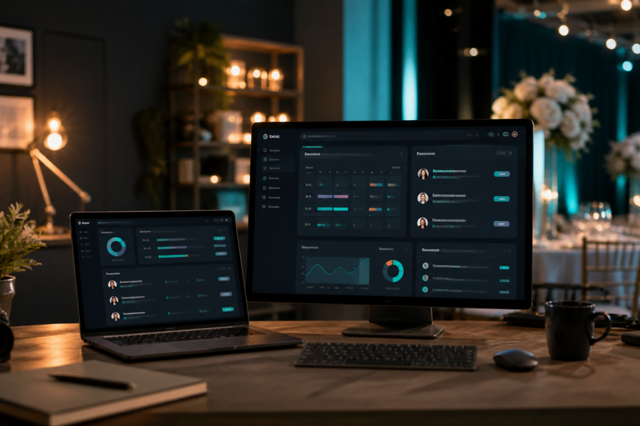
This is, in a fairly direct way, the exact problem Culpass exists to solve. You're not organizing corporate events in Spain often enough to build your own supplier network from scratch, and you shouldn't have to. Culpass gives you a platform to request proposals from verified venues and suppliers across Spain, compare pricing and availability in one place, and manage bookings and payments without juggling fifteen separate email threads in a language you may not speak.
What makes the difference on the day, though, isn't only the software. Alongside the platform, Culpass has a real team that works with you directly and with the supplier at the same time, chasing confirmations, catching problems before they become your problem, and being reachable when something needs sorting out at short notice. That combination, a platform to organize everything plus people who actually follow up on both sides, is what most international teams are missing when they try to plan a Spanish event from an inbox abroad.
We won't pretend it removes every friction point. Some suppliers are slow to respond no matter who's asking, and peak season in Madrid and Barcelona (spring and early autumn especially) means the best venues book out months ahead regardless of who you go through. What we can shorten is everything else: the sourcing, the comparing, the paperwork, and the coordination that usually eats the most time for a team managing this from outside Spain.
Frequently asked questions
Do I need a Spanish legal entity to organize a corporate event in Spain? No. Most foreign companies book venues and suppliers directly as a foreign entity, with invoicing handled according to the VAT rules that apply to your specific situation. You don't need a Spanish subsidiary just to run an event here, though it's worth confirming the invoicing details with your finance team before signing contracts.
How far in advance should we start planning? For a group under 50 people, two to three months is usually workable. For anything larger, or if you want a specific venue in Madrid or Barcelona during April to June or September to November, four to six months gives you a real choice instead of whatever is left.
Do Spanish event suppliers speak English? Larger, international-facing venues and suppliers in Madrid and Barcelona generally do. Smaller or more specialized suppliers, particularly outside the two main cities, often don't, or only partially. This is one of the more common reasons companies bring in a local partner rather than book everything directly.
How does payment usually work? Expect a deposit of 30 to 50% on booking, with the remainder due shortly before the event. Terms vary by supplier and by how far in advance you're booking, so it's worth getting cancellation terms in writing before you commit.
Can the whole thing be managed remotely, or does someone need to fly in early? Sourcing, contracting and most of the planning can happen remotely without issue. For the event day itself, having someone physically present, whether that's a member of your own team or a local partner, makes a real difference when something needs solving in real time.
Is Spain more affordable than organizing the same event in the UK or France? Generally, yes, particularly for venue hire and catering, though the gap has narrowed somewhat over the past couple of years. It still tends to compare favourably against London, Paris or Zurich for a similar scale of event.
Plan your next corporate event in Spain with Culpass
If your team is trying to organize a corporate event in Spain from outside the country, Culpass connects you with verified venues and suppliers across Spain and pairs the platform with a team that follows up on your behalf, so the comparison and the paperwork happen in one place instead of across a dozen email threads. If you're weighing a broader offsite format specifically, our guide on how to organise a corporate offsite in Spain goes deeper into budgets and programme structure, and if Barcelona is on your shortlist, our Barcelona venue guide breaks down the main options by size and format.

Nacho Kleinman es cofundador y CEO de Culpass y escribe sobre tecnología, eventos corporativos, automatización e innovación aplicada a la experiencia de cliente. Su trabajo se centra en ayudar a las empresas a simplificar la organización de eventos mediante software, datos e inteligencia artificial.